
Medicare covers this

Don’t spend your hard-earned money on items that insurance will cover

“Family caregivers also spend on average 20% of their already-lower earnings on caregiving-related expenses — money they are not saving for their own futures.” (Forbes, 2021)

Ellen’s mom has trouble sleeping and is having some trouble with incontinence. Ellen spends quite a lot of money per year on sleeping aids and adult “underwear”. She heard about sleep apnea and a CPAP machine and wondered if that was something she should ask her mother’s doctor about. Little did she know that Medicare would cover both of these items.

Wouldn’t it be great to get the most out of Medicare coverage? We chased down some of the items that you may be paying for—and found that Medicare will pay instead!

When you sign up for Medicare, you have to sign up for the Original Medicare policy, which includes Parts A and B. Medicare Part C, is also known as the Medicare Advantage policy. Medicare Part D is an optional add on, just like Part C. Read about the differences of Parts A, B, C and D on medicare.gov.

Medicare covers a range of things, including some products and services that you buy. We pulled together a list of eight items that you may not know are covered by Medicare.

Are you paying for these 8 items?

#1 COVID Test

You pay nothing for this test when you get it from a laboratory, pharmacy, doctor, or hospital, and when Medicare covers this test in your local area.

#2 Screening for Depression

Medicare Part B covers one depression screening per year. 

#3 Incontinence Supplies

There are some Part C plans available throughout the country that will offer benefits for products like adult diapers. Yet, these plans are only in specific service areas. In some cases, no plans with this benefit may exist in your location, but it’s worth checking.

#4 Insulin

Starting January 1, 2021, you may be able to get Medicare drug coverage through the Part D Senior Savings Model that offers broad access to many types of insulin for no more than $35 for a month’s supply. You can get this savings on insulin if you join a Medicare drug plan or Medicare Advantage Plan with drug coverage that participates in the insulin savings model. This model lets you choose among drug plans that offer insulin at a predictable and affordable cost.

#5 A CPAP Machine

One surprising piece of equipment that is typically covered, partially, by Medicare is a Continuous Positive Airway Pressure (CPAP) Therapy equipment. This machine helps those who are diagnosed with obstructive sleep apnea to breath and sleep better through the night. It also helps those who are sleeping with them from whacking them with pillows to keep them from snoring.

#6 Advance Care Planning 

Advanced care is planning for care you would get if you become unable to speak for yourself.

Medicare Part B covers voluntary advance care planning as part of your yearly “Wellness” visit. The medical staff can help you fill out an advance care directive or POLST form. Medicare may also cover this service as part of your medical treatment. 

#7 Hospice / Palliative Care

There are plenty of Medicare-approved hospices across the country under the Original Medical policy. To qualify for hospice care, a hospice doctor and your doctor (if you have one) must certify that you’re terminally ill, meaning you have a life expectancy of 6 months or less.

#8 Smoking & Tobacco Cessation Counseling 

Medicare Part B covers up to 8 visits of smoking and tobacco-use cessation counseling visits in a 12-month period.

We have done our best to make certain this information is accurate, but confirmation of coverage can only be confirmed through your particular Medicare plan and provider. 

May you find joy in loving one another well.

Elizabeth Dameron-Drew is the Co-founder and President of Ways & Wane. She walked closely with her own father through his years of waning. She lives near Seattle with her two teenage sons, husband and two rescue dogs. 

PTO for a parent

“Hi mom, how did it go at your doctor’s appointment today?”

“Well, they said that I needed a new medication to help me remember things.”

“What was the diagnosis that they were treating?”

“I’m not really sure
”

It used to be that she took you to the doctor, sat in the vinyl chair next to the paper covered recliner, asked the doctor all the right questions and filled out all the forms. 

Now it’s you in that vinyl chair and she is sitting on the paper covered recliner quietly, like she used up all her questions when she asked them on your behalf—all those years ago. 

When did you start realizing that you wanted to attend doctor’s appointments together?

It may seem easier to go to appointments with your older adult so you can get the whole story. Although it can be a bit of a tightrope as you respect their independence and ask the tough questions. 

Out of love and necessity, I’ve been an advocate for a seriously ill family member in the hospital and at doctor appointments literally hundreds of times over the past 19 years.

I’ve learned a few things in that time. I’ve summarized it for you.

Six Ways to Be a Bold Medical Advocate

#1. You are the customer. There is something about a doctor title that can be intimidating, but it doesn’t change the fact that they are there to make sure your needs are met. Also, you are paying for the care.

#2. Arrive with your questions written out and don’t let the doctor leave the room until you’ve taken the time you need to make sure all the questions were asked and the answers understood. That means even if the doctor is standing at the door waiting while you are reviewing your notes.

#4. If you aren’t given the expertise, time and attention you need, find a new doctor. You don’t need to tolerate care that doesn’t meet your needs. It’s even okay if it’s because the doctor’s attitude or demeanor isn’t a fit.

#5. Ask for what you need. One time (to avoid embarrassing my family member) at check in I told the receptionist that I wanted to talk to the doctor privately at some point. Another time I asked the nurse to use the term “coach” instead of “hospice” in front of my dad. Many times I asked for a hallway conversation. 

#5. Make sure you know how to contact the doctor for follow-up concerns or questions. Weekend? After hours? Text? Email? As information sinks in, more questions will likely arise.

#6. Don’t hesitate to ask the doctor to use plain terms and simple explanations if they are using terminology that isn’t easy to understand. It’s okay that you (probably) didn’t go to medical school. I have some training through Grey’s Anatomy, but it may not be complete.

Use the right tools

One of the tools I have always used is a portable medical planner. I tried keeping notes on my phone, but found that it took too long to bring it up and type in answers, etc. so I used all my experience at the doctor’s office and hospital to create what I believe people need. I even designed the cover and taught myself InDesign so I could do the layout. Then I added pockets for organizing all the things. Just today, we got this feedback which delighted me


“I received the GoKit yesterday and I was very impressed. Here are some of my first impressions:

  1. Loved the size. Easy to carry.
  2. I like that it doesn’t look like a medical document planner. That was important for my family because my mom wanted to look at our homemade notebook and we had to disguise it.
  3. I like how the book reminds, encourages and speaks to the caregiver in the blue bubbles.
  4. It is great that the divider pages are color pages. Relaxation technique built in!
  5. If I had received this from my employer, I would have felt totally supported and cared about!”

Click here to download a page from the “Doctor” section of the planner. Use it to help you prepare and navigate the next appointment for your older adult.

May you find joy in loving one another well.

Elizabeth Dameron-Drew is the Co-founder and President of Ways & Wane. She walked closely with her own father through his years of waning. She lives near Seattle with her two teenage sons, husband and two rescue dogs. 

In-Home Care Program

I wonder if the older adult you are caring for qualifies for this federal and state funded program?

PACE enables certain home-dwelling elderly individuals to remain in the community rather than receive care in a nursing home.

PACE stands for Program of All-Inclusive Care for the Elderly. It’s a partnership between a state’s social services and federally-funded Medicaid or Medicare. There are 272 PACE centers in 30 states, serving approximately 55,000 participants. PACE organizations provide care and services in the home, the community, and the PACE center. Medicare and Medicaid funds are used to cover all medically-necessary care and services provided by PACE. While each PACE program follows specified guidelines, each center is independently run so services may vary.

If your older adult qualifies for this program, it could be a game changer! Following is a fast-track checklist to determine if PACE is an option for the older adult in your life.

family caregiver making notes

Does the older adult meet the following criteria?

✅ Is 55 years old or older

✅ Is a full-time resident in the service area of a PACE organization (This includes these states: Alabama, Arkansas, California, Colorado, Delaware, Florida, Indiana, Iowa, Kansas, Louisiana, Maryland, Massachusetts, Michigan, Ohio, Oklahoma, Oregon, Nebraska, New Mexico, New York, North Carolina, North Dakota, Pennsylvania, Rhode Island, South Carolina, Tennessee, Texas, Virginia, Washington, Wisconsin, Wyoming.)

✅ Lives within the geographic area covered by a PACE center in their state. This map shows the specific PACE locations in each state. Also, because new programs are being added, check the map to see the most current national coverage information.

✅ Can be certified by the state in which they live as meeting the need for nursing home level care

✅ Is able to live safely in the community with the help of PACE services

✅ Qualifies for Medicaid. PACE centers may be able to help you fill out Medicaid paperwork and check to see if you qualify. (You can access PACE by paying privately. The private pay amount is usually on par with the cost of a nursing home, but the participant would still have the cost of their own living situation so paying privately for PACE doesn’t really make financial sense, that’s why 90-95% of PACE participants qualify for Medicaid.)

If an older adult qualifies based on the criteria above, PACE can provide:

  • Adult day primary care (including doctor and recreational therapy nursing services)
  • Dentistry
  • Emergency services
  • Home care
  • Hospital care
  • Laboratory/x-ray services
  • Meals
  • Medical specialty services
  • Nursing home care
  • Nutritional counseling
  • Occupational Therapy
  • Physical therapy
  • Prescription drugs
  • Preventive care
  • Social services, including caregiver training, support groups, and respite care
  • Social work counseling
  • Transportation to the PACE center for activities or medical appointments, if medically necessary. You may also be able to get transportation to some medical appointments in the community.

This brief video gives a glimpse of life at a PACE program.

Pay special attention to these other key points about the PACE program:

  • When enrolled in PACE, participants must receive Medicare and Medicaid benefits solely through the PACE organization. This means that you may have to change doctors and use the providers at your PACE center. 
  • PACE assumes total financial risk and pays for ALL health care services. This means that if the participant is hospitalized or needs surgery and rehab, all that cost is covered when arranged by PACE.
  • The interdisciplinary care team at PACE works with the participants and their caregivers to create a plan of care, meaning the participant and caregiver have a voice in the care plan. Also, because providers usually care for a small number of people, they get to know their patients and care is less fragmented.
  • Financing for the program is capped, which allows providers to deliver all services participants need rather than only those reimbursable under Medicare and Medicaid fee-for-service plans. For example, Medicare will only pay for a certain amount of physical therapy, but PACE doesn’t have that limitation.
  • PACE organizations are required to provide enrollees with all medically necessary services, including drugs, without any limitation or condition as to the amount, duration, or scope.  
  • Medical equipment can be requested and provided through PACE.
  • PACE provides all the care and services covered by Medicare and Medicaid when/if authorized by the PACE health care team. If the health care team decides you need care and services that Medicare and Medicaid doesn’t cover, PACE may still cover them.
  • If you need help completing a Medicaid application to enroll in PACE, your local PACE center can help you with that process.
  • Participants can disenroll at any time and resume their Medicaid and Medicare programs.

If an older adult meets the criteria for PACE and has access to one in their area, it could allow an older adult to age in their own home. That’s a dream come true for many! If you are ready to dive even deeper into PACE, we can evaluate it and other paying for care options with our stress-free Paying for Care service.

May you find joy in loving one another well.

Elizabeth Dameron-Drew is the Co-founder and President of Ways & Wane. She walked closely with her own father through his years of waning. She lives near Seattle with her two teenage sons, husband and two rescue dogs.


A little help, please

ONE question that reduces “overwhelm” when caring for an older adult with dementia, Alzheimer’s or physical needs

You don’t need to do it all and you definitely don’t need to do it all by yourself. As a family caregiver, there are times when someone else cannot fill your shoes, but there are many tasks someone else can do.

Before you add a task to your to-do list, ask
“Do I have to be the one to do this?” 

Put support systems in place for yourself so that you can show up in the areas where no one can replace you.

No one can replace you in your tradition of getting a root beer float with your older adult from the drive through.

No one can replace your sweet reminiscing through a photo album. 

But someone can remove some of the other day-to-day tasks that fall on your shoulders. Now more than ever, remote and home support services are pretty widely available.  If you are worried about the expense, set a weekly amount that you would pay to be less stressed. Then hire a few tasks out.

What could that look like? 

5 Ways to Delegate

Here are 5 ideas where spending a little bit of money can provide essential support for you, the family caregiver.

  1. Laundry service. There are places that charge just $1 a pound to pick up your laundry from a bag on your porch, wash it, fold it and return it to your porch. (Think cloth diaper service, but better.)
  2. Ready-to-prepare meals. Amazon Fresh used to charge extra for their grocery delivery, but now it’s included in a Prime membership and is free when you meet the minimum purchase amount. They have fresh, ready-to-prepare meals that even a non-cook can pull together like Kung Pao Chicken, No-Prep Kit for 2 for about $14. (It was yummy.)
  3. Hire self-care. There are companies like Zeel who have professional massage therapists who will come to your home. I tried it twice and to answer what you are wondering—it’s not creepy at all.
  4. Leverage your family, the neighborhood college kid or someone from your faith organization to do errands for you. Dropping off the package to UPS, returning the library book or picking up the Walgreens order for your older adult are all things you can ask someone else to help with. Or choose a company like TaskRabbit when you need a second set of hands or wheels to finish your to-do list. When you need an errand runner, book a Tasker to pick up prescriptions, make a trip to the post office, or complete any other one-off on your list. 
  5. Hire in-home help 10 hours a week. If you are concerned about finding good help and how to pay for it, look at our “How to Pay for Care” package. We’ll make sure you get all the benefits that you qualify for!

In a season that can be very intense, taking things off your plate so you can show up where you are not replaceable can make a huge difference to your level of stress and overall mental health. 

May you find joy in loving one another well.

Elizabeth Dameron-Drew is the co-founder and president of Ways & Wane. She walked closely with her own father through his years of waning. She lives near Seattle with her two teenage sons, husband and two rescue dogs. When she’s not working on this platform she’s probably creating books, doing research or planning a dinner party while listening to the rain and thinking about her next creative endeavor.

Free Respite Help

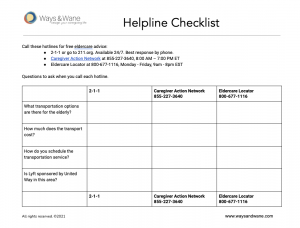
Dial 2-1-1 anytime of the day or night to get respite care resources (and other help) in your area

For example, a search on the 211 website:  www.211.org showed me resources near me, like the Jewish Family Service Caregiver Support Program which can offer respite help. I also found a link there that showed me 14 Adult Day Care options ranging from $0-65/day.
As a nonprofit funded by United Way and local governments, 2-1-1 made more than 12.8 million help connections in 2018. It’s free to have them help you.

Here are four reasons why you should call 2-1-1 for answers about local nursing homes, walker recommendations, senior transportation and in-home care.

  1. 2-1-1 referrals are free.
  2. 2-1-1 is government-funded, but it is not just for the poor. The operators can give you information about support groups, housing options and caregivers.
  3. 2-1-1 gives you names and numbers of local companies, nonprofits or agencies that will provide the services your senior needs. 
  4. 2-1-1 is open 24/7 and available by phone (best) or chat at 211.org or by text. They report that 94.6% of the U.S. population can access a local 2-1-1 center. My call was answered quickly by phone, but not at all by text. 

Calling 2-1-1 would have given me a starting point to getting more help for my dad. Here’s a checklist of questions to ask 2-1-1 when you call, so you don’t forget anything.

Now may you have peace as you help an older adult in their waning phase of life.

Debbie McDonald is the Founder of Ways & Wane, an online platform that helps you help your aging parent. She lives in Northern California with her husband.

This company benefit could save you thousands in caregiving expenses

Will your company pay for eldercare?

As you assist your elderly parent or in-law, you may not think about your employer as a resource. Instead you wonder if they are getting the most out of Medicare benefits and worry about their physical or cognitive decline. 

woman on phone looking worriedMany employers offer a benefit to support your caregiving efforts. In fact, a Bank of America survey found that while 88 percent of the surveyed employers offer some type of caregiving resources, 71 percent of workers are unaware of these offerings, and just 34 percent have taken advantage of them.

Caregiving in the spotlight

With the proposed American Family Plan offering paid family leave to care for an older adult and the outcry over women caregivers leaving the workplace, employers are in the hotseat to offer more caregiving benefits. If your company does offer eldercare benefits, they likely exist within one of five different areas. If they don’t, now is the time to politely ask your human resources contact to consider adding an eldercare benefit. 

A sibling or their partner can also qualify for an eldercare company benefit to provide assistance. Asking them to check into their company benefit can be a good way to get siblings involved.

Five places to look for it

An eldercare benefit may fall into several areas within a company:

  • Adult care
    Like a child daycare benefit, some employers cover backup in-home care or adult daycare.
  • Employee Assistance Program
    The EAP may provide eldercare navigation resources to help you find in-home care, pay for care, determine which legal documents you need and more.
  • Employee Resource Group
    Some large companies offer an Employee Resource Group (ERG) supporting employees caring for an older adult. Employees experiencing similar eldercare challenges may meet regularly to share resources and support.
  • Dependent Care Flexible Spending Account
    Using pre-tax dollars to private pay for eldercare expenses, can save you 20% or more depending on your tax bracket. According to the Society of Human Resource Management, “While the benefit is most often used to pay for child day care, elder care also is eligible for reimbursement with a DCFSA if the adult lives with the account holder at least eight hours of the day and is claimed as a dependent on the account holder’s federal tax return.”
  • Family Leave
    Some companies offer a leave of absence that is paid, unpaid or a combination of the two so that you can attend to your loved one’s needs for an extended period of time. This can be especially useful during intense times of transition from hospital to rehab to another living situation. 

    Email your HR department

    Within larger companies, it can be difficult to find what benefits exist and how to access them. Copy and paste this message into an email and send to your human resources department:

    To Human Resources:
    Does our company offer any kind of eldercare benefit?
    Do we have an eldercare Employee Resource Group?
    What is our family leave policy as it relates to caring for an older adult?
    As I look forward, this benefit would be helpful.
    If we are considering a caregiver benefit, Ways & Wane solves eldercare challenges for busy professionals. I’d like to work with them. Will you reimburse employees for that expense?

    Your employer values your focused contributions; offering caregiver benefits allows you to do your best work and creates a high return on investment for your employer.

    Debbie McDonald is founder of the iCareToo movement and CEO of Ways & Wane, a benefit that solves eldercare challenges for busy professionals.

    Respite Care Provided Through Hospice for a Dementia Patient

    Hospice Qualifies You for Respite Care

    It isn’t what you think.

    The hospice representative called to let me know that dad qualified for the program. 

    I told her, “I think we’re still okay to hold off.” 

    Two weeks later she called, “Do you want to rethink hospice care?” 

    I said no. 

    My dad’s dementia had become more severe, but he was still talking and eating well and he (mostly) knew who I was. That said, no one knows your person like you do. You can see how they are slipping away while others may not detect it. 

    It sounded so final to engage hospice.

    We had no idea how quickly he would decline. Within two weeks, he was gone.

    Grandpa holding grandson

    While I do my best to live my life without regrets, believing first to trust that things do not happen by chance, I wondered how his last days would have been different had we engaged hospice sooner. 

    Could I have been with him in those last moments? Would he have been more comfortable? Would my sister and brother and his grandchildren have been able to say good-bye? 

    A nurse would have visited him frequently, making sure he was comfortable. We would have had someone to call 24 hours a day, instead of the reluctant once-a-month visit from his doctor’s office. There would have been on-site medication oversight and administration. We would have truly known his condition.

    People are either afraid of hospice or wish they’d engaged hospice earlier. I’d like to highlight a few of the facts here, particularly as it relates to dementia, and explain how hospice can support the caregiver with respite care. 

    Three points about hospice according to Medicare

    1. To qualify for hospice care, a hospice doctor and your doctor (if you have one) must certify that you’re terminally ill, meaning you have a life expectancy of 6 months or less. 
    2. When you agree to hospice care, you’re agreeing to comfort care (palliative care) instead of care to cure the illness. 
    3. You also must sign a statement choosing hospice care instead of other benefits Medicare covers to treat the terminal illness and related conditions. 

    One of the services hospice provides is respite care for the family caregiver. 

    Especially when caring for someone with dementia or Alzheimer’s, the mental, emotional and physical toll on the caregiver can be enormous, making respite for the caregiver essential. 

    Here are four things to know about respite care through hospice:

    1. Depending on the terminal illness and related conditions, the plan of care the hospice team creates can include inpatient respite care, which is care provided in a Medicare-approved facility (like an inpatient facility, hospital, or nursing home), so that the usual caregiver can rest. 
    2. Your hospice provider will arrange this for you. 
    3. Patient transport is included and you can stay up to 5 days each time you get respite care. 
    4. You can get respite care more than once, but only on an occasional basis. 

    For more information about paying for care, check this video by Author Cameron Huddleston.

    Dementia is a disease with no cure so it qualifies as terminal, which qualifies a dementia patient for hospice. But how then is life expectancy predicted? 

    Crossroads Hospice and Palliative Care, a private company serving a handful of states, mainly in the Eastern U.S., says this about eligibility. For patients with dementia, it may be time to consider hospice when the patient’s physical condition begins to decline. According to Crossroads, some key things to look for include:

    • A diagnosis of other conditions as COPD, CHF, cancer or congenital heart disease
    • An increase in hospitalizations, frequent visits to the doctor and/or trips to the ER
    • A diagnosis or pneumonia or sepsis
    • Weight loss or dehydration due to challenges in eating/drinking
    • Speech limited to six words or less per day
    • Difficult swallowing or choking on liquids or food
    • Urinary and fecal incontinence
    • Unable to sit upright without armrests on chairs or may slip out of chairs and require sitting in special chairs
    • Unable to walk without assistance such as a walker or now requiring a wheelchair
    • Unable to sit up without assistance (will slump over if not supported)
    • No longer able to smile

    Check the Hospice Foundation of America for what is included and not included in hospice care, how to choose a provider and how to begin the process.

    This Sunday, June 13th marks the two year anniversary of my dad’s last breath on this earth. I’ll be taking off on a family road trip that day and thinking a lot about how much he loved to drive and explore and what an honor it was to call him daddio.

    May you find joy in loving one another well.

    Elizabeth Dameron-Drew is the Co-founder and President of Ways & Wane. She walked closely with her own father through his years of waning. She lives near Seattle with her two teenage sons, husband and two rescue dogs. When she’s not working on Ways & Wane she’s probably creating books, doing research work or planning a dinner party while listening to the rain and thinking about her next creative endeavor.

    Three Ways to Pay for Long-term Care

    Secret Cost-Saving  Strategies

    Long-term care is expensive, right?!
    We have three little-known tips to share.

    mom with dementia, daughter helping with paperwork

    211.org This free service is the most comprehensive source of locally curated social services information. Available 24/7–call, text or chat.
    State Health Insurance Program (SHIP)
    This nonprofit gives free advice about Medicare programs that could provide financial assistance. Call to schedule an appointment with someone from your state.
    Programs of All-inclusive Care for the Elderly (PACE)
    This is a Medicare and state-specific “shared care” program for those who qualify. (You don’t necessarily need to spend down assets like you would to qualify for Medicaid.) It is not available in every state.

    One support group participant was so excited that they qualified and will receive help through this program!

    May you find joy in discovering new strategies to pay for long-term care!

    Dementia-Friendly Mother’s Day

    Seven Sweet Ideas to Celebrate

    mom with dementia and daughter celebrating at lunchMother’s Day is frequently a day filled with emotion, especially if your mother is suffering from dementia. Acknowledging the emotion—the joy, the grief, the regret, the love—and creating a plan for the day, transforms it. I gathered some sweet ideas for you, whether your own mom is still with you or not.

    If your mom is with you (but not entirely), try these ideas.
    1. Share happy memories about her from the past, reminding everyone who she is.
    2. Celebrate all her senses with her favorite music and yummy scents. 
    3. Get a manicure together. (Maybe the grandchildren can do nails for you & grandma!)
    4. Look at a picture album together.
    5. Tell stories from her life where she was funny/bright/successful, etc.
    6. Take an easy trip to a park or a beautiful drive. Just get out of the house.
    7. Simply cherish that she’s still with you, even if the dementia has caused her not to know you.
    8. Buy a gift that keeps her hands busy.
    If your mom has passed away, remember her in one of these ways.
    1. Try out a hobby she loved. Maybe doing so will provide new insight into her.
    2. Repurpose a piece of her jewelry. 
    3. Make a donation in her honor.
    4. Frame her handwriting (maybe it’s a recipe card or a note).
    5. Spend time with others who loved her too and enjoy reminiscing. 
    6. Celebrate another mother in your life.
    7. Take a break from social media so you aren’t bombarded with Mother’s Day pictures that could make the day even harder for you.

    If you anticipate that other family members will be grieving that day too, consider including them in the planning of something. 

    Whatever the day looks like for you, may you feel love and express love!

    Elizabeth Dameron-Drew is the Co-founder and President of Ways & Wane. She walked closely with her own father through his years of waning. She lives near Seattle with her two teenage sons, husband and two rescue dogs. When she’s not working on this platform she’s probably creating books, doing research work or planning a dinner party while listening to the rain and thinking about her next creative endeavor.
    Sibling Relations

    One sibling usually takes the lead. How can others get involved?

    caregiver woman worried

    Sibling relationships as they relate to care for aging parents—t’s pretty much the perfect storm of potential conflict. A dynamic that taps into long-term emotional wounds, inheritance concerns and parental/sibling life memories going back many years. In the midst of the conflict, especially if you feel like you’re the one holding all of the responsibilities, where can solutions and practical coping strategies be found?  


    Let’s begin by looking at three reasons why siblings may avoid helping with caregiving:

    1. They don’t think/see that there’s a need

    2. They don’t see how they can help

    3. They are afraid of doing a “bad job” or messing up


    So let’s break these down into strategic responses


    They don’t see a need. How about


    • Send a calendar invite for specific times they can fill in.

    • Set up a regular whole family meeting (including spouses) to review the situation. Then make a date for the next whole family meeting.

    • Start a family message thread or a private family Facebook group providing regular updates and encouraging dialogue.

    • Create a shared google document outlining updates, questions and challenges.

    • Use a website like Caring Bridge or Lotsa Helping Hands to outline needs


    They don’t see how they can help. How about asking them to do something specific, like…

    • Take over bill paying, banking and/or tax management.

    • Cover the cost of a bi-monthly housekeeper or helper. (One family I know had all the kids and grandkids pitch in for a year of housecleaning for their great grandma.)

    • Have a meal delivered every week (or every so often).

    • Gift a membership (massage, yoga, etc.) for the family member who does most of the care.

    • Research solutions to various needs, e.g. find a used wheelchair, the best shower chair, etc.


    They might be afraid of doing a “bad job” or messing up. How about encouraging based on these perspectives…

    • Accept siblings for who they are and expect different approaches.

    • Try to respect other’s perceptions and find opportunities to compromise.

    • “Decide to believe that everyone is truly doing the best that they can. We’re all a little bit right and a little bit wrong.” – Life Coach Mary Remmes

    • Assume positive intent.


    At the end of the day, we can only control how WE respond. Caregiving isn’t easy, so extra grace is hugely helpful—all around.

    May you find joy in loving one another well and assuming the best

    Elizabeth Dameron-Drew is the Co-founder and President of Ways & Wane. She walked closely with her own father through his years of waning. She lives near Seattle with her two teenage sons, husband and two rescue dogs. When she’s not working on this platform she’s probably creating books, doing research work or planning a dinner party while listening to the rain and thinking about her next creative endeavor.